Public Banking Works. Here’s the Proof.
Instead of accepting the system as it is, we should be asking,
“What kind of financial system do we want? And how can we make it better serve our communities and the real needs of the people who live here?”
Public banking offers one proven answer.
Public banking is a proven model with more than a century of success in the United States and a long history of supporting communities around the world.
Consider the Bank of North Dakota (BND). Founded in 1919, this publicly owned bank has a 100+ year track record strengthening the state's economy, supporting local businesses, helping communities weather economic downturns, and generating profits. Profits that result in returns to the state budget for better roads and schools.
Today, the bank holds $10.7 billion in assets, earns hundreds of millions of dollars annually, and maintains a strong A+ credit rating from Standard & Poor's, a better rating than either Goldman Sachs or J.P. Morgan.
North Dakota's success isn't unique. Around the world, more than 900 publicly owned banks collectively hold over $55 trillion in assets, 20% of global banking assets. From Germany to Costa Rica, these long-established financial institutions help finance businesses, housing, infrastructure, and other community needs.
“Public banking is revolutionary; it is also extremely old-fashioned,” says Christine Desan, a professor at Harvard Law School.
Public banks can be “financial first responders” after natural disasters and economic downturns. During the Great Recession, BND expanded lending when big banks pulled back. During the 2025 federal government shutdown, it partnered with local banks to provide emergency loans to families with delayed paychecks and public benefits like SNAP.
There is no question whether public banks can succeed as financial institutions. North Dakota and public banks around the world demonstrate that every day. What sets public banks apart is what they make possible for communities: greater control over public dollars, access to affordable housing, thriving small businesses, clean energy investments, good jobs, and increased income for local governments.
North Dakota: More Than 100 Years of Results
The Bank of North Dakota has demonstrated how a public bank can strengthen local economies during good times and respond when communities face difficult challenges.
AVOIDING THE GREAT RECESSION. When the 2008 financial crisis caused banks across the country to pull back on lending, BND was unaffected, and able to expand its loan portfolio by 30.6%. Its partnerships with community banks helped sustain local lending during a difficult period.
HELPING SMALL BUSINESSES SURVIVE COVID-19. When the pandemic struck, BND helped community banks and credit unions deliver 20,000 Paycheck Protection Program loans totaling more than $1.7 billion. North Dakota led the nation in emergency business lending per private-sector worker during the program's first round.
HELPING FAMILIES DURING THE 2025 FEDERAL SHUTDOWN. Within a week of the shutdown, BND announced a low-interest emergency loan program for federal workers missing paychecks. Working with 30 local banks, it provided $1.6 million in loans to 129 workers, helping families pay bills and meet everyday expenses until their paycheck finally showed up.
FINANCING LOCAL BUSINESSES. In 2025, BND continued working with local banks to fund 595 business loans totaling $1.7 billion. These partnerships are adding additional capital to local lenders and helping them provide business loans that might otherwise be beyond their lending capacity.
INVESTING IN COMMUNITY INFRASTRUCTURE. BND administers $1.3 billion in state-directed financing programs with other lenders supporting school construction, clean water systems, medical facilities, and other essential infrastructure.
RETURNING PROFITS TO THE PUBLIC. Unlike private banks that distribute profits to shareholders, BND can return earnings to the state. In 2025, BND provided $2111 million for the state's general fund.
These results show that a public bank can be financially successful while helping local lenders, businesses, families, and communities thrive.
North Dakota Isn't Alone. Public Banking Works Around the World.
Publicly owned banks are an established part of their financial systems and collectively hold 20% of the world’s banking assets. The 900 public banks’ structures and missions vary, but their accomplishments demonstrate the breadth of what public banking can achieve.
Costa Rica: Public service and a major role in national infrastructure. This profitable and well-run bank holds about one-third of Costa Rica’s banking business. Its sound management and public orientation helped it get the country through both the 2008 financial crisis and the COVID-19 pandemic’s unprecedented economic challenges smoothly. The Banco Popular, part of the public bank infrastructure, is under the supervision of a workers’ assembly of just under 300 people who are selected for their participation in economically and socially important Costa Rican social groups
Germany: Supporting businesses and local communities. Germany's Savings Banks Finance Group, built around locally focused public savings banks known as Sparkassen, helped to provide €94.5 billion in new loans to businesses and self-employed people in 2025. The group also contributed more than €500 million to regional projects, including sports, arts, and cultural activities.
Canada: Demonstrating financial strength. Alberta's publicly owned ATB Financial reported C$ 61.2 billion in loans and C$ 543 millions in annual profits for fiscal 2026. ATB helps finance homes, businesses, and economic activity across the province.
Norway: Financing renewable energy. In 2016, the publicly owned Nordic Investment Bank provided approximately €49.5 million in financing for six hydropower plants in northern Norway, supporting renewable energy generation and regional infrastructure.
These are different public banking models, but they demonstrate that public ownership allows financial institutions to pursue broader economic and community benefits alongside financial stability.
What Could Public Banking Mean for the East Bay?
North Dakota has demonstrated what a public bank can accomplish. Now imagine what we could build here.
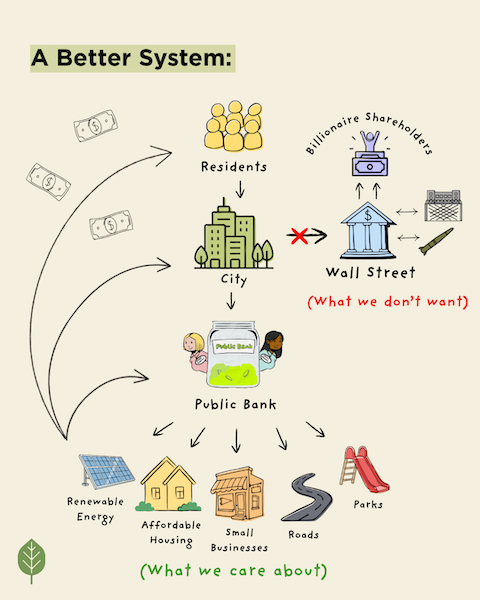
What if more of our public dollars were working to address the challenges we see in our neighborhoods every day?
Public Bank East Bay will partner with community banks, credit unions, and nonprofit lenders to expand financing for:
AFFORDABLE HOUSING that helps families stay in their communities.
THRIVING SMALL BUSINESSES that create good jobs, strengthen neighborhoods, and build local wealth.
CLEAN ENERGY INFRASTRUCTURE that lower costs, strengthen community resilience, and support a just transition to a healthier future.
A stronger, more equitable economy depends in part on who makes financial decisions, where our money goes, and who benefits from those investments.
The East Bay doesn't have to start from scratch. We can build on generations of experience and create a public bank that reflects our communities, values, and priorities.